

Enterprise Technology Stack Explained: How Software, Cloud, AI, Security, DevOps, Data, and Architecture Fit Together
Cluster Guide
Enterprise Technology Stack Explained: How Software, Cloud, AI, Security, DevOps, Data, and Architecture Fit Together
The enterprise technology stack is the connected set of business applications, cloud infrastructure, data platforms, AI systems, cybersecurity controls, DevOps practices, and enterprise architecture decisions that allow an organization to operate, adapt, and scale. It is not a random collection of tools. It is the operating system behind modern digital business.
This guide is the central cluster map for The Tech Silo. It explains how the major technology layers connect, where each layer creates value, how decisions in one layer affect the others, and how leaders can use the stack to plan modernization, reduce fragmentation, and improve governance.


What is the enterprise technology stack?
The enterprise technology stack is the total system of technology capabilities that supports an organization’s work. At the visible layer, employees and customers interact with business systems such as ERP, CRM, analytics dashboards, collaboration platforms, service management tools, and workflow software. Underneath those systems are cloud infrastructure, identity controls, integrations, data pipelines, cybersecurity monitoring, deployment processes, and architecture decisions.
The stack matters because business outcomes rarely live inside one tool. A customer-service improvement may involve CRM data, ERP order history, a knowledge base, a cloud-hosted application, identity controls, analytics dashboards, and an AI assistant. A cloud migration may affect application portfolios, security architecture, cost governance, CI/CD pipelines, logging, data residency, disaster recovery, and business continuity.
For this reason, the enterprise stack should be treated as an operating model, not just a technology inventory. A tool inventory tells you what the organization owns. A stack model explains how capabilities depend on each other, where risk lives, where data moves, how decisions should be governed, and which modernization steps should happen first.
The seven layers of the stack
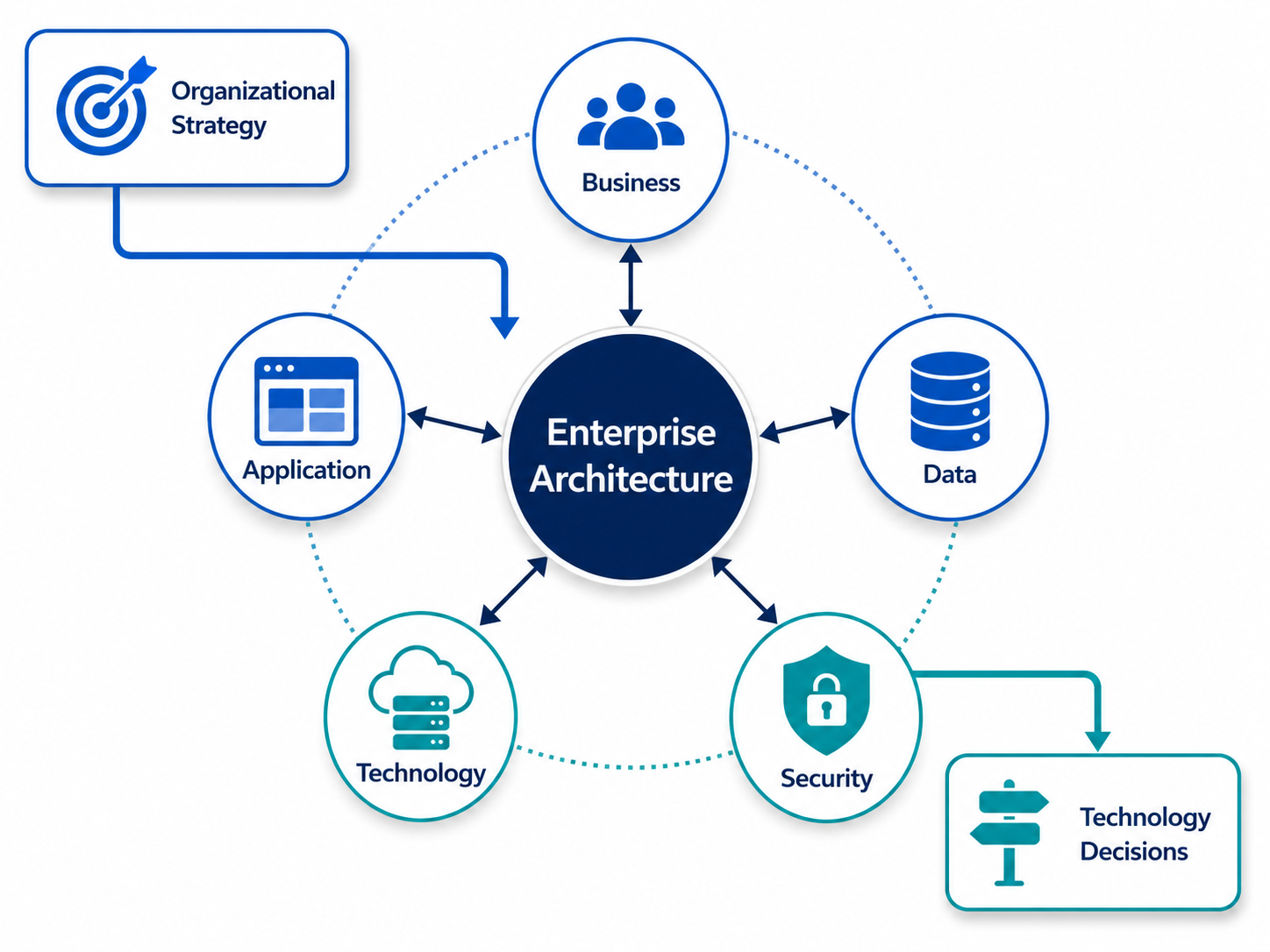
The Tech Silo uses seven core layers to organize enterprise technology decisions. The layers are not perfectly separate in practice, but the model helps teams ask better questions and avoid narrow tool-by-tool thinking.
| Layer | Primary question | Typical decisions | Core Tech Silo guide |
|---|---|---|---|
| Enterprise Architecture | How does technology support strategy? | Capability maps, roadmaps, standards, governance, portfolio decisions | What Is Enterprise Architecture? |
| Enterprise Software | Which business systems run core work? | ERP, CRM, SaaS platforms, workflows, application portfolios | What Is Enterprise Software? |
| Cloud Infrastructure | Where do systems run and scale? | Compute, storage, networking, identity, public/private/hybrid cloud | What Is Cloud Infrastructure? |
| Data Platforms | How is trusted information collected and used? | Warehouses, lakes, pipelines, governance, analytics, metadata | What Is a Data Platform? |
| AI Infrastructure | How are AI systems built, grounded, monitored, and governed? | RAG, vector search, model platforms, evaluation, monitoring, governance | What Is AI Infrastructure? |
| Cybersecurity | How are users, systems, data, and workflows protected? | Zero trust, IAM, SIEM, SOAR, cloud security, access control | What Is Zero Trust Security? |
| DevOps & Reliability | How are systems delivered, operated, observed, and improved? | CI/CD, automation, observability, incident response, reliability engineering | What Is DevOps? |
Enterprise architecture is the map
Enterprise architecture connects business capabilities, applications, data, infrastructure, security, operations, and governance. It helps leaders decide which systems should be kept, consolidated, modernized, retired, or replaced. It also prevents every technology problem from becoming another disconnected tool purchase.
Enterprise software is the business operating layer
Enterprise software includes the systems that run daily business work. ERP, CRM, HR, workflow, collaboration, service, and finance systems create the records and processes that other layers depend on. The ERP vs CRM guide explains how two major enterprise software categories serve different but connected business needs.
Cloud infrastructure is the operating foundation
Cloud infrastructure provides compute, storage, networking, identity, automation, and operations capabilities. Good cloud decisions consider workload type, compliance, latency, resilience, cost, team skills, operating model, and security controls. The public cloud vs private cloud vs hybrid cloud comparison explains major deployment patterns.
Data platforms create the trusted information layer
Data platforms collect, store, govern, transform, and share information from business systems, applications, infrastructure, customer interactions, and operational workflows. The data warehouse vs data lake comparison explains two major architectural patterns for enterprise data.
AI infrastructure adds intelligence on top of trusted systems
AI infrastructure supports the design, deployment, monitoring, and governance of AI systems. It includes data access, retrieval systems, embeddings, vector search, model endpoints, prompt management, evaluation, observability, security, and policy controls. The RAG Architecture Explained guide shows how retrieval-augmented generation connects AI systems to enterprise sources.
Cybersecurity protects every layer
Cybersecurity protects identities, applications, data, infrastructure, workflows, and operations. It must be designed into enterprise software, cloud environments, data pipelines, AI systems, and DevOps workflows. Security operations also need visibility, which is why the SIEM vs SOAR comparison matters for detection and response workflows.
DevOps and reliability keep the stack moving
DevOps and reliability cover the practices used to build, release, operate, monitor, and improve systems. The CI/CD pipeline is one of the core patterns for moving change safely through the stack.
Recommended implementation roadmap
The best way to use this cluster is to follow the roadmap from architecture visibility to operational maturity. Each guide builds on the previous one and strengthens a different layer of the stack.
| Step | Guide | Why it comes here |
|---|---|---|
| 1 | Enterprise Architecture Roadmap Example | Creates the capability, system, data, cloud, security, AI, and delivery map. |
| 2 | Cloud Governance Framework | Turns cloud usage into a controlled operating model with cost, security, ownership, and compliance guardrails. |
| 3 | AI Governance Framework | Defines responsible AI controls before AI systems become unmanaged business infrastructure. |
| 4 | Zero Trust Maturity Model | Improves identity, access, data protection, monitoring, and continuous verification. |
| 5 | Data Governance Framework | Creates ownership, definitions, quality controls, metadata, lineage, privacy, and AI-ready data. |
| 6 | DevOps Maturity Model | Improves the delivery and operations engine that keeps the stack changing safely. |
How the layers work together
Consider a company that wants to launch an AI customer service assistant. At first, the initiative may sound like an AI project. In practice, it crosses the full stack.
| Stack layer | AI customer service assistant dependency |
|---|---|
| Enterprise Software | CRM records, support tickets, order history, account status, and service workflows |
| Data Platforms | Knowledge base ingestion, customer data quality, metadata, lineage, and access rules |
| AI Infrastructure | Retrieval, embeddings, model endpoint, prompt templates, evaluation, and feedback loops |
| Cloud Infrastructure | Hosting, scaling, storage, networking, backup, and environment automation |
| Cybersecurity | Identity, least privilege, sensitive-data controls, logging, monitoring, and policy enforcement |
| DevOps & Reliability | CI/CD, release controls, observability, rollback, incident response, and support ownership |
| Enterprise Architecture | Business fit, roadmap alignment, application portfolio impact, governance, and risk approval |
This example shows why a connected stack model is more useful than a simple technology list. A successful AI assistant is not only a model choice. It is a software, data, cloud, security, operations, and architecture decision.
Enterprise stack decision framework
Use the following framework before approving a major technology initiative. It helps teams identify dependencies early, reduce implementation surprises, and create clearer ownership.
| Question | What to check | Evidence to request |
|---|---|---|
| What business capability does this support? | Strategy alignment, users, process impact, measurable outcome | Capability map, business case, success metrics |
| Which systems are affected? | Applications, integrations, owners, lifecycle status | Application portfolio map, integration diagram |
| What data is involved? | Definitions, quality, classification, lineage, retention, access | Data catalog entry, data owner approval, privacy review |
| Where will it run? | Cloud model, network, regions, resilience, cost, backup | Cloud architecture, cost estimate, recovery requirements |
| How will it be protected? | Identity, least privilege, logging, encryption, security monitoring | Security architecture, threat model, access review |
| How will it change over time? | CI/CD, observability, incident response, owners, roadmap | Release plan, runbook, monitoring dashboard |

Governance checklist
- Map the business capabilities supported by each major platform.
- Maintain an application portfolio with owners, lifecycle status, integrations, and risk notes.
- Create cloud governance standards for landing zones, identity, tagging, cost, logging, backup, and exceptions.
- Define data ownership, quality rules, metadata, lineage, classification, and access reviews.
- Apply AI governance before AI tools process sensitive data or influence business decisions.
- Use zero trust controls for identity, devices, applications, workloads, data, and monitoring.
- Improve DevOps maturity through CI/CD, automated testing, observability, incident response, and platform engineering.
- Review architecture decisions regularly and document exceptions with owners and expiry dates.
Common mistakes
Treating the stack as a tool list
A stack model should explain dependencies, ownership, risk, and value. A list of platforms is not enough.
Modernizing one layer while ignoring others
Cloud migration without data governance, AI adoption without access control, or DevOps automation without security can create new risk.
Skipping ownership
Every major application, dataset, cloud account, AI system, security control, and pipeline needs a business and technical owner.
Using governance as a blocker
Good governance creates guardrails and reusable patterns. It should make the safe path easier, not slower.
FAQ
What is included in an enterprise technology stack?
An enterprise technology stack includes business applications, cloud infrastructure, data platforms, AI infrastructure, cybersecurity controls, DevOps practices, and enterprise architecture governance.
Why does the enterprise technology stack matter?
It matters because business outcomes depend on connected systems. Software, data, cloud, AI, security, operations, and architecture decisions affect each other.
Who owns the enterprise technology stack?
Ownership is shared. Enterprise architecture coordinates the map, but business owners, platform teams, security, data, cloud, AI, DevOps, and application teams all own parts of the stack.
How should organizations modernize the stack?
Start with architecture visibility, then strengthen cloud governance, AI governance, zero trust maturity, data governance, and DevOps maturity. This creates a sequence instead of scattered modernization projects.
How does AI change the enterprise technology stack?
AI increases the need for trusted data, permission-aware retrieval, monitoring, evaluation, security controls, governance, and reliable deployment practices.
Recommended reading path
- Enterprise Architecture Roadmap Example
- Cloud Governance Framework
- AI Governance Framework
- Zero Trust Maturity Model
- Data Governance Framework
- DevOps Maturity Model
Final takeaway
The enterprise technology stack is the operating model behind modern digital business. It works best when enterprise software, cloud infrastructure, data platforms, AI infrastructure, cybersecurity, DevOps, and enterprise architecture are designed together. The strongest organizations do not manage these layers as disconnected departments. They connect them through roadmaps, ownership, governance, metrics, reusable patterns, and continuous improvement.