What Is Enterprise Architecture? Strategy, Frameworks, and Roadmaps

What Is Enterprise Architecture? Strategy, Frameworks, Governance & Roadmaps
Editorial review
Written by The Tech Silo Editorial Team. Reviewed for enterprise architecture frameworks, business capability modeling, application portfolio management, data governance, cloud infrastructure integration, security architecture, operating models, and technology roadmap strategy. Updated: June 22, 2026.
Parent hub: Enterprise Architecture
Enterprise architecture is a discipline that helps organizations connect business strategy with technology decisions. It provides leaders with a structured framework to understand organizational capabilities, applications, data flows, infrastructure investments, security controls, and governance standards before making major technology changes. In complex organizations managing hundreds of systems, EA creates a coherent map for decision-making, cost optimization, security, and transformation.
Short answer
Enterprise architecture is a systematic approach to aligning business goals with technology systems. It helps organizations design, evaluate, and manage applications, data, infrastructure, security, operating models, and transformation roadmaps as an integrated whole—rather than as disconnected, expensive point solutions that create technical debt and governance gaps.
The five pillars of enterprise architecture
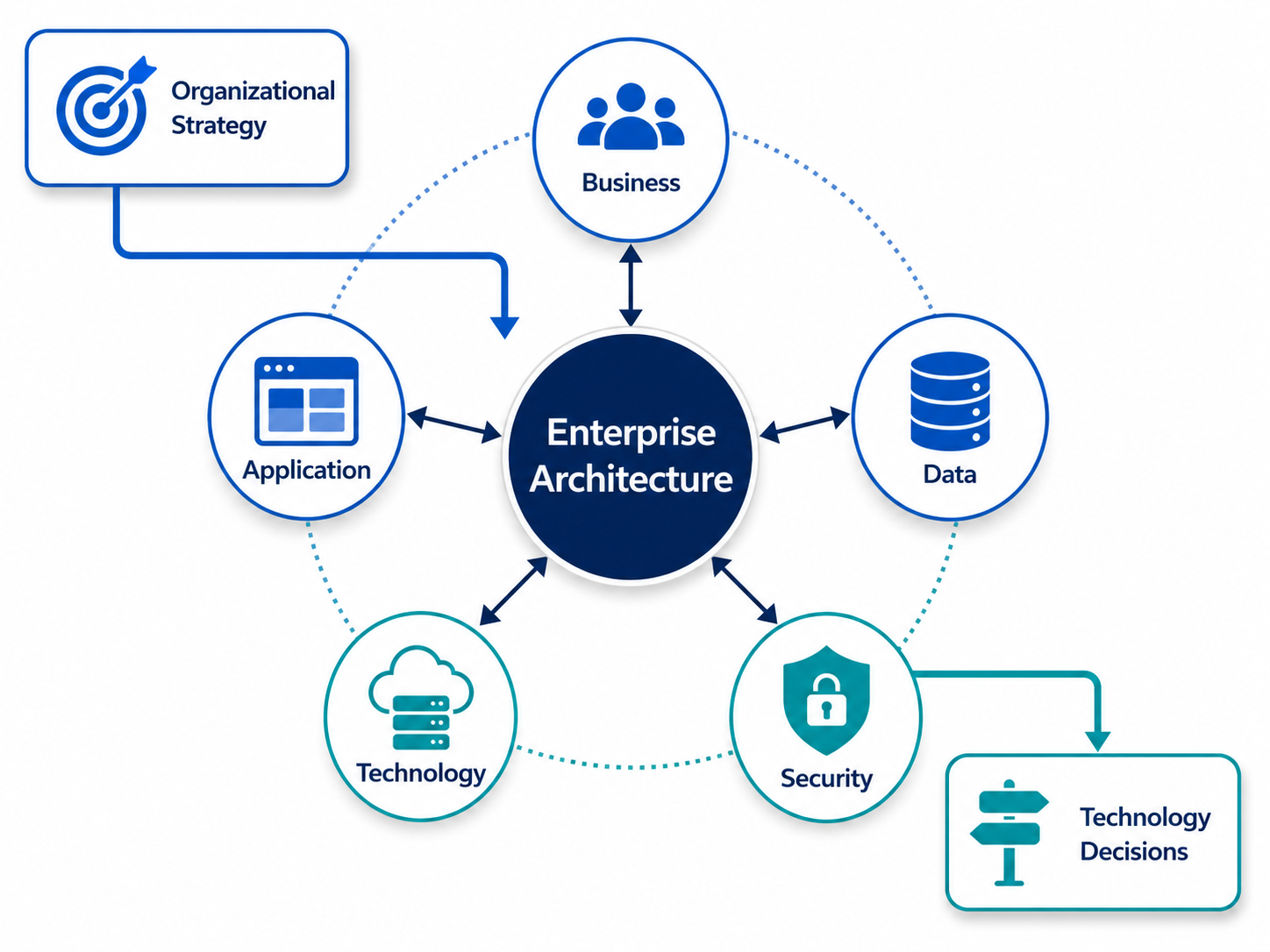
Modern enterprise architecture is typically organized into five interdependent domains. Each domain addresses a critical aspect of organizational structure, technology delivery, and strategic alignment:

Business architecture
Business architecture maps organizational capabilities, processes, value streams, and stakeholder roles. It answers critical questions: What does the organization do? What are its competitive capabilities? How do business processes connect to technology? Business architects work with strategy and operations teams to document the current operating model and design the target operating model that new technologies should support. This ensures technology investments align with business objectives rather than pursuing technology for its own sake.
Key deliverables: Capability maps, process models, value stream diagrams, organizational structure, business rules documentation, operating model designs.
Application architecture
Application architecture defines the software systems, platforms, integrations, and technology stacks that support business capabilities. It maps which applications deliver which functions, how they integrate, their technical maturity, cost, security posture, and whether they should be maintained, modernized, replaced, or consolidated. Poor application architecture leads to system sprawl, technical debt, integration nightmares, and inflated operational costs. Strong application architecture enables faster feature delivery, reduced costs, and improved security outcomes.
Key deliverables: Application portfolio maps, system integration diagrams, technology stack inventory, modernization strategies, cloud vs. on-premises analysis, API architecture, SaaS vs. custom decision matrices.
Data architecture
Data architecture governs how information flows through the organization, who owns it, how it’s stored, secured, governed, and used for analytics and decision-making. Poor data architecture leads to isolated data silos, inconsistent definitions, governance gaps, compliance violations, and ineffective analytics. Modern data architecture enables real-time insights, regulatory compliance, cross-functional collaboration, and AI-ready systems. It connects data quality, master data management, data lineage, and governance frameworks into a coherent whole.
Key deliverables: Data inventories, master data management designs, data lineage diagrams, governance frameworks, metadata standards, data warehouse or data lake architectures, analytics platform strategy, data platform roadmaps.
Technology architecture
Technology architecture defines the infrastructure, cloud platforms, networks, middleware, databases, and operational environments that host applications and data. It addresses critical strategic questions: Should we adopt public, private, or hybrid cloud? How do we containerize applications? What are our disaster recovery and business continuity requirements? Technology architecture translates application and data needs into concrete infrastructure investments, cost models, and operational capabilities that enable business delivery.
Key deliverables: Cloud platform strategy, infrastructure-as-code designs, network architecture, database strategies, disaster recovery and business continuity plans, operational environment designs, DevOps and reliability roadmaps.
Security architecture
Security architecture defines controls, identity management, access governance, risk assessment, and compliance standards across all other architecture domains. It addresses authentication and authorization (IAM), data protection, network segmentation, application security, threat modeling, and compliance with regulations like SOC 2, HIPAA, GDPR, and industry standards. Security cannot be bolted on after architecture—it must be integrated from the beginning. Organizations that design security into architecture reduce breach risk, accelerate compliance, and avoid costly remediation.
Key deliverables: Zero trust frameworks, identity and access management designs, risk registers, compliance mappings, security standards and controls documentation, threat models, security governance frameworks, incident response plans.
Why enterprise architecture matters to organizations
Without enterprise architecture, technology decisions accumulate over time in fragmented, disconnected ways. Teams working in silos build redundant solutions, creating overlapping capabilities, poor integrations, and complex dependencies. This leads to several predictable problems:

- Fragmented systems: Multiple teams build disconnected solutions, creating duplicate capabilities, poor integrations, and hidden technical debt that compounds over time.
- Rising costs: Redundant systems, manual workarounds, integration complexity, and poor utilization of expensive cloud and license investments inflate operational budgets.
- Security and compliance gaps: Inconsistent security standards, unmanaged access, unclear data flows, and audit readiness challenges increase breach risk.
- Slow transformation: Major changes become risky because no one fully understands what systems exist, how they connect, or what might break during modernization.
- Loss of business agility: New capabilities take months to build because teams must navigate complex system dependencies and governance questions that were never clearly answered.
Enterprise architecture addresses these problems by creating a shared, documented view of what exists, why it was built, how it connects, what the target state should be, and what should change first. When practiced well, EA reduces technical debt by 20-30%, accelerates modernization timelines by 40%, improves security posture by reducing gaps, enables faster feature delivery, and makes large technology investments less risky.
Enterprise architecture frameworks & methodologies
Several established frameworks provide structure and discipline for enterprise architecture work. Each offers different approaches to organizing architecture domains, governance, and implementation:
TOGAF (The Open Group Architecture Framework)
TOGAF is the most widely adopted EA framework in large enterprises globally. It defines the Architecture Development Method (ADM), a structured cycle for developing target architectures, identifying gaps between current and target states, and planning implementation. TOGAF covers architecture domains, governance models, tools, and industry patterns. It’s particularly strong for regulated industries and organizations with formal governance requirements. Organizations using TOGAF typically have stronger governance discipline and more documented architecture decisions.
Best for: Large enterprises, regulated industries, organizations adopting formal EA practice with governance boards and documented decision-making.
Zachman Framework
Zachman provides a two-dimensional matrix showing architecture from multiple perspectives (stakeholder views: planners, owners, designers, builders) across six abstractions (from Scope to Implementation). It’s highly structured and useful for comprehensive artifact management and traceability. The framework excels at creating complete documentation but requires discipline to maintain taxonomy and avoid bureaucratic overhead.
Best for: Organizations requiring detailed artifact traceability, compliance documentation, and complete architecture cataloging across multiple stakeholder perspectives.

Federal Enterprise Architecture (FEA) Reference Models
FEA was developed by the U.S. federal government to standardize EA across agencies. Its reference models cover business functions, performance measures, information, and technology. Many enterprises—particularly in government, healthcare, and financial services—adapt FEA concepts for internal governance frameworks.
Best for: Government agencies, regulated industries, organizations with strict audit and reporting requirements, large-scale standardization initiatives.
Best practices for enterprise architecture
1. Start with business capabilities, not tools
Too many architecture initiatives begin with “We should adopt Kubernetes” or “We need a data lake.” Instead, start with business strategy: What capabilities must we build? What problems are we solving? What will differentiate us from competitors? Then evaluate technology options that serve those capabilities. This ensures architecture drives business value rather than adopting technology for its own sake.
2. Document current state before designing target state
You can’t close a gap you don’t understand. Invest in comprehensive current-state documentation—even if it’s imperfect. Without a baseline, roadmaps lack credibility and risk misses. Current-state documentation also builds organizational awareness of technical debt and fragmentation that may be invisible to executives.
3. Connect all architecture domains into an integrated whole
Siloed architecture domains fail. A world-class cloud architecture that ignores data governance or security will become expensive and risky. Build integration points between domains (business ↔ application ↔ data ↔ technology ↔ security) and ensure teams are talking to each other regularly.
4. Use governance to guide without slowing decisions
Excessive governance paralyzes organizations. Effective governance defines principles and standards upfront (e.g., “All applications must log to our SIEM”), then trusts teams to make decisions within guardrails. Reserve exception approvals for genuinely novel choices that introduce organizational risk.

5. Make roadmaps visible and regularly reviewed
Publish roadmaps broadly and review them at least quarterly as business and technology needs change. Communicate the “why” behind sequencing decisions so stakeholders understand trade-offs. Hidden roadmaps breed confusion and organizational conflict.
6. Make EA accessible to all, not just architects
Architecture artifacts that only architects understand create dependency and slow decision-making. Use clear visual models, maintain searchable documentation, and train teams on how to use architecture artifacts. Make architecture a shared language across engineering, product, and leadership teams.

Related reading
Enterprise Architecture hub · Cloud Infrastructure · Data Platforms · Cybersecurity · DevOps & Reliability
Subscribe to The Tech Silo Brief · Browse all topics · Editorial Policy
Bottom line
Enterprise architecture is the map that helps organizations make better technology decisions. It connects strategy, software, data, cloud, security, operations, and governance into a coherent roadmap for change. Whether you’re managing a large enterprise navigating dozens of legacy systems, a fast-growing software company building cloud-native architecture, or a regulated industry organization balancing innovation with compliance, enterprise architecture provides the framework for coherence, governance, and strategic alignment. Organizations that invest in EA realize 20-30% cost reductions, faster modernization, improved security, and better organizational alignment around technology decisions.