


Capability Map Example: How to Map Business Capabilities, Applications, Data, Cloud, and AI
Enterprise Architecture · Capability Mapping
Capability Map Example: How to Map Business Capabilities, Applications, Data, Cloud, and AI
A capability map is a structured view of what an organization does, independent of who does it, which application supports it, or how the current process is implemented. It groups business capabilities such as customer management, product management, order management, finance, risk, analytics, and technology operations into a stable map that enterprise architects can use for planning, investment, modernization, and governance.
Capability maps are useful because technology roadmaps often become too system-focused. Teams discuss CRM, ERP, cloud migration, data platforms, cybersecurity tools, and AI assistants without first agreeing which business capabilities need improvement. A capability map creates the business lens. It helps leaders see where value is created, where systems overlap, where data matters, where risk is concentrated, and where modernization should start.

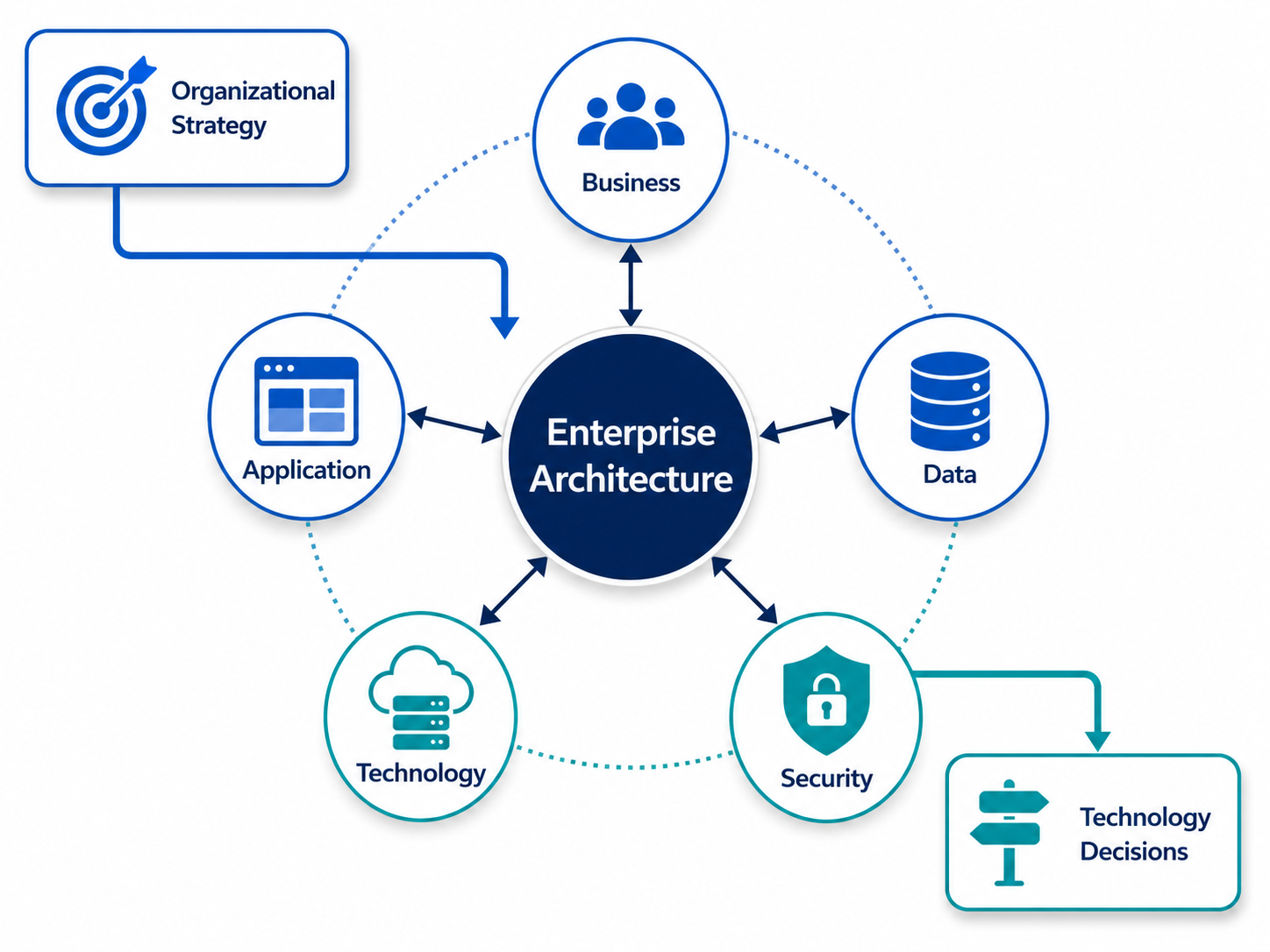
What is a capability map?
A capability map is a model of what a business must be able to do to deliver value. It is different from an organization chart, process map, system diagram, or project roadmap. An organization chart shows teams and reporting lines. A process map shows sequence and workflow. A system diagram shows technology components. A capability map shows stable business abilities.
For example, an insurance company may have capabilities such as product design, underwriting, policy administration, claims management, customer service, risk management, billing, analytics, compliance, and technology operations. A retailer may have capabilities such as merchandising, inventory management, pricing, order fulfillment, customer loyalty, returns management, supplier management, and omnichannel commerce.
The value of a capability map is stability. Processes change, teams reorganize, applications are replaced, and cloud platforms evolve, but core business capabilities tend to remain recognizable. This makes the capability map a strong anchor for enterprise architecture, application portfolio management, data governance, cloud planning, cybersecurity, and AI strategy.
Capability maps are usually hierarchical. Level 1 capabilities describe broad capability groups. Level 2 capabilities break those groups into more specific abilities. Level 3 capabilities may describe the level needed for application mapping, ownership, investment planning, or transformation roadmaps.
Why capability mapping matters
Capability mapping matters because it connects business strategy to technology decisions. Without a capability map, technology planning often starts with tools: which CRM should we buy, which ERP module should we upgrade, which data platform should we build, or which AI assistant should we deploy. Those questions are useful, but they should follow a clearer business question: which capabilities need to improve and why?
A capability map helps answer that question. It can show which capabilities are strategic, which are underperforming, which are expensive, which rely on fragile applications, which use poor-quality data, which have compliance exposure, and which are strong candidates for automation or AI. That gives leaders a better basis for prioritization.
Capability mapping also improves cross-functional language. Business teams may talk about processes and outcomes. IT teams may talk about systems. Data teams may talk about domains and pipelines. Security teams may talk about access and risk. Cloud teams may talk about workloads. A capability map creates a shared structure where these perspectives can meet.
This is why capability mapping is a natural next step after application portfolio management. The application inventory tells you what systems exist. The capability map explains what business abilities those systems support. Together, they help enterprise architects identify redundancy, modernization priorities, investment gaps, and governance risk.
Capability map example
The example below shows a simplified capability map for a mid-sized B2B technology company. The exact map should be adapted to the organization, but the pattern is reusable.
| Level 1 capability | Level 2 capabilities | Example applications | Architecture concern |
|---|---|---|---|
| Customer Management | Account management, contact management, customer service, customer success | CRM, support desk, customer portal | Duplicate customer records and inconsistent account ownership |
| Revenue Management | Lead management, opportunity management, quoting, pricing, billing | CRM, CPQ, ERP, billing platform | Fragmented quote-to-cash process and manual handoffs |
| Product Management | Product strategy, roadmap, catalog, release planning, lifecycle management | Product roadmap tool, PIM, engineering backlog | Weak connection between product roadmap and technical roadmap |
| Delivery and Operations | Project delivery, service delivery, incident management, change management | ITSM, project management, monitoring tools | Operational data is spread across multiple tools |
| Data and Analytics | Reporting, analytics, data governance, data engineering, AI readiness | Data warehouse, BI platform, catalog, ML tools | Unclear ownership for critical metrics and source data |
| Risk and Compliance | Policy management, audit, privacy, security governance, vendor risk | GRC platform, IAM, SIEM, policy repository | Controls are not consistently mapped to applications and data |
| Technology Enablement | Cloud platforms, DevOps, enterprise architecture, cybersecurity, integration | Cloud console, CI/CD, API gateway, observability stack | Platform standards vary across teams and environments |
This example is not meant to be perfect or universal. It shows how a capability map creates a structured conversation. Instead of debating one system at a time, leaders can ask which capabilities are most important, where the architecture is weak, and what the roadmap should improve first.
Capability levels and decomposition
Capability maps work best when the levels are clear. Too shallow, and the map is not useful for decisions. Too detailed, and the map becomes hard to maintain. A practical enterprise architecture map usually has two or three levels.
| Level | Purpose | Example |
|---|---|---|
| Level 1 | Shows broad business capability areas for executive planning. | Customer Management |
| Level 2 | Breaks a capability area into more specific business abilities. | Account Management, Customer Service, Customer Success |
| Level 3 | Supports detailed mapping to systems, data, controls, projects, and ownership. | Customer Profile Management, Contact Preference Management, Case Escalation |
The most common mistake is confusing capabilities with processes. “Manage customer profile” is a capability. “Customer updates address through support portal” is closer to a process or user journey. Capabilities describe what the business must be able to do; processes describe how work flows to accomplish it.
Another common mistake is naming capabilities after systems. “Salesforce management” is not a business capability. “Customer relationship management” or “opportunity management” is. The same capability may be supported by Salesforce today, another CRM tomorrow, and an AI-assisted workflow later.

Mapping applications, data, cloud, and AI
The capability map becomes powerful when it is connected to other architecture views. A capability on its own is useful for business language. A capability mapped to applications, data, cloud platforms, security controls, and AI use cases becomes a decision tool.
| Mapping layer | Question to answer | Example insight |
|---|---|---|
| Applications | Which systems support this capability? | Three tools support customer service, creating overlap and inconsistent case history. |
| Data | Which data domains does this capability create or consume? | Customer Management depends on customer, account, contact, consent, and support data. |
| Cloud infrastructure | Where do the supporting workloads run? | Critical customer workloads are split across SaaS, public cloud, and legacy hosting. |
| Cybersecurity | Which identities, controls, and risk levels apply? | High-value capabilities need stronger access reviews and monitoring. |
| AI opportunities | Where could AI improve decisions, service, automation, or knowledge work? | Customer Success can use AI for case summarization, next-best action, and knowledge retrieval. |
| DevOps and reliability | How are supporting systems changed, operated, monitored, and recovered? | Revenue systems need stronger deployment controls and incident ownership. |
This mapping also improves prioritization. A capability that is strategically important, supported by fragile applications, dependent on sensitive data, and targeted for AI automation should receive more architectural attention than a low-value capability with stable systems and low risk.
Capability heatmap and scoring
A capability heatmap is a visual or tabular scoring model that shows where attention is needed. It can highlight investment priority, current maturity, technical risk, data quality, security exposure, cost pressure, or AI opportunity.
| Capability | Business importance | Current maturity | Technology risk | Data quality | Roadmap priority |
|---|---|---|---|---|---|
| Customer Management | High | Medium | Medium | Low | Now |
| Revenue Management | High | Low | High | Medium | Now |
| Product Management | Medium | Medium | Low | Medium | Next |
| Data and Analytics | High | Low | Medium | Low | Now |
| Risk and Compliance | High | Medium | High | Medium | Next |
The heatmap should not become a political scoring exercise. The goal is to create a shared view of where capability improvement would create the most value or reduce the most risk. Scoring works best when the criteria are defined clearly and reviewed with business owners.
90-day capability mapping roadmap
A capability map can start small. The first version does not need to describe the entire enterprise in perfect detail. It should cover the capabilities most relevant to current decisions.
| Timeframe | Focus | Deliverables |
|---|---|---|
| Days 1–30 | Define scope and first map | Business domain selection, Level 1 capabilities, stakeholder list, draft capability definitions |
| Days 31–60 | Connect systems and data | Level 2 capabilities, application mapping, owner mapping, data domain mapping, major pain points |
| Days 61–90 | Score and turn into roadmap | Capability heatmap, modernization priorities, governance decisions, roadmap themes, next-step backlog |
Good starting domains include customer management, revenue management, finance, supply chain, risk and compliance, data and analytics, and technology enablement. Choose a domain where leaders already need decisions. Capability mapping creates value faster when it supports an active roadmap, merger, cloud migration, platform consolidation, or AI initiative.

Common mistakes
Turning the map into an organization chart
Capabilities should describe what the business does, not how teams are structured. Organization charts change more often than capabilities.
Naming capabilities after applications
A capability should not be named after a vendor or system. “CRM administration” is not as useful as “customer relationship management” or “opportunity management.”
Making the map too detailed too early
Too much detail can slow adoption. Start with Level 1 and Level 2 capabilities, then go deeper only where decisions require it.
Ignoring ownership
Every important capability should have a business owner or accountable stakeholder. Without ownership, the map becomes a diagram rather than a governance tool.
Disconnecting the map from roadmaps
A capability map should influence investment decisions, application rationalization, data governance, security planning, cloud migration, AI readiness, and DevOps priorities.
FAQ
What is a capability map?
A capability map is a business architecture model that shows what an organization must be able to do. It organizes business capabilities into a structured map that can be used for strategy, application planning, data governance, modernization, and roadmap decisions.
What is the difference between a capability map and a process map?
A capability map shows what the business must be able to do. A process map shows how work flows. Capabilities are usually more stable; processes may change when teams, systems, channels, or automation patterns change.
How many levels should a capability map have?
Most practical capability maps use two or three levels. Level 1 gives an executive view, Level 2 supports planning, and Level 3 supports application, data, ownership, or roadmap mapping where needed.
Who owns capability mapping?
Enterprise architecture or business architecture usually facilitates the map, but business stakeholders should own capability definitions, priorities, and value judgments.
How does capability mapping support application portfolio management?
It connects applications to business capabilities. This helps teams find duplicate applications, unsupported capabilities, modernization priorities, and systems that should be invested in, consolidated, replaced, or retired.
How does capability mapping support AI strategy?
Capability mapping helps identify where AI could improve decision-making, service, automation, analysis, or knowledge work. It also shows which data, systems, controls, and owners are needed before AI can be used safely.
Recommended reading path
- Enterprise Technology Stack Explained
- Enterprise Architecture Roadmap Example
- Application Portfolio Management Explained
- Cloud Governance Framework
- Data Governance Framework
- AI Governance Framework
Final takeaway
A capability map helps enterprise architecture start with the business instead of the toolset. It creates a stable language for strategy, applications, data, cloud, security, AI, and roadmaps. The most useful capability maps are not decorative diagrams. They connect capabilities to owners, systems, data, risks, costs, maturity, and investment decisions. Start with a focused domain, build a practical Level 1 and Level 2 map, connect it to the application portfolio, then use a heatmap to turn architecture insight into roadmap action.